
Choosing sounders is one of the quickest ways to under or over specify a fire alarm design. The calculation is not difficult once you know the target level and how sound falls away with distance. This guide walks through it step by step with worked examples.
The levels and clause references below are from BS 5839-1:2025 (clause 15 and Annex C), summarised in our own words. This is a guide for designers, not a substitute for the standard, so always read the clauses themselves and any project specification (see also our BS 5839-1:2025 round-up).
What Does BS 5839-1:2025 Ask For?
For Category M and Category L systems, and for Category P systems in areas where audible alarms are required, clause 15 says that, measured with all doors shut:
- 65 dB(A) minimum throughout all accessible areas (clause 15.1.1a). Specifically designated areas from which the fire and rescue service is summoned (clause 14.4, where the signal should not interfere with telephone speech) and areas of less than 1 m² have no minimum.
- 60 dB(A) minimum is acceptable in stairways, in enclosures of not more than approximately 60 m² (for example cellular offices) and at specific points of limited extent (clause 15.1.1a, Figure 6).
- 75 dB(A) at the bed head in rooms where the system is intended to rouse people from sleep (clause 15.1.1b). The standard notes that this normally means a sounder in the room.
- No more than 120 dB(A) at any normally accessible point (clause 15.1.1c).
- 5 dB(A) above background noise where the background noise is greater than 60 dB(A) (clause 15.1.3). Background noise that is unlikely to last longer than 30 seconds can be ignored, and the recommendation does not apply to running water in bathrooms and shower rooms.
- Fundamental frequency of 500 Hz to 1,000 Hz unless background noise would mask it, and a continuous output (clause 15.1.4).
- At least two sounders, with at least one in each fire compartment (clause 15.1.10).
On measurement, the standard notes that a sound level meter to BS EN 61672-1 set to slow response and A-weighting is suitable, and that levels within 500 mm of walls or partitions need not be considered (other than at the bed head) unless that would leave a space of more than 1 m² without an adequate level. It also says the alarm signal can be taken to be 5 dB above the background noise if the reading rises by 6 dB when the system operates.
The commentary adds two points worth remembering. A difference of 2 to 3 dB is only just perceptible, so there is no need for extra sounders just to gain a tiny improvement. And a larger number of quieter sounders is preferable to a few very loud ones.
Step 1 - Work Out The Level You Need
Start at 65 dB(A) (or 60 dB(A) in the areas where the standard allows it). If the background noise is above 60 dB(A), add 5 dB(A) to the background level, which will then be the higher figure. For sleeping rooms the target at the bed head is 75 dB(A).
If you do not have measured figures, Annex C of the standard gives typical background noise levels. It advises using the higher figure of the range, and measuring in the real building wherever possible. Three examples from Annex C:
- Quiet uncarpeted corridor, 45 to 55 dB(A): the higher figure, 55, is below 60, so the 65 dB(A) minimum applies.
- Commercial kitchen, 65 to 75 dB(A): 75 + 5 = 80 dB(A).
- Light assembly area in a factory, 80 to 85 dB(A): 85 + 5 = 90 dB(A).
Step 2 - Find The Sounder Output At 1 Metre
Manufacturers publish sounder output in dB(A) measured at 1 m, usually for a stated tone and volume setting. Use the figure for the setting you will actually install. In the examples below we use an illustrative sounder rated at 100 dB(A) at 1 m. Check the datasheet for the real device.
Step 3 - Apply The Inverse Square Law
In open air, sound level falls by about 6 dB every time the distance doubles. The formula is:
Level at distance d = Level at 1 m - 20 × log10(d)
For our 100 dB(A) sounder that gives, to the nearest whole decibel:
- 1 m: 100 dB(A)
- 2 m: 94 dB(A)
- 4 m: 88 dB(A)
- 8 m: 82 dB(A)
- 16 m: 76 dB(A)
- 32 m: 70 dB(A)
- 64 m: 64 dB(A)
To go the other way and find the distance at which a sounder drops to the level you need, rearrange the formula:
Distance = 10 ^ ((Level at 1 m - Required level) / 20)
Worked Examples
Example 1 - Quiet Corridor
Required level 65 dB(A). Distance = 10 ^ ((100 - 65) / 20) = 10 ^ 1.75 = about 56 m in free field conditions. That is a theoretical upper limit. Real buildings have walls, furniture, bends and doors, so the useful distance will be shorter.
Example 2 - Light Assembly Area
Required level 90 dB(A). Distance = 10 ^ ((100 - 90) / 20) = 10 ^ 0.5 = about 3 m. The same sounder that covers a long corridor covers only a small part of a noisy production area, so you need more devices or a louder one. Remember the 120 dB(A) limit at normally accessible points when you add output.
Example 3 - Bedroom With The Sounder In The Corridor
Target 75 dB(A) at the bed head, with the door shut. BS 5839-1 does not give a figure for how much a door reduces sound, so this example uses an assumed loss of 20 dB(A) for an ordinary door. Manufacturers commonly quote figures of this order, with a fire door higher, but the real value depends on the door and its gaps and has to be checked on site.
With that assumption, the level needed at the outside of the door is about 75 + 20 = 95 dB(A). Distance from the sounder = 10 ^ ((100 - 95) / 20) = about 1.8 m. That is only possible if the sounder is almost next to the door, and it ignores the distance across the room to the bed. If the door lost 30 dB(A) you would need about 105 dB(A) at the door, which our 100 dB(A) sounder cannot deliver even at 1 m. This is consistent with the note to clause 15.1.1b that a sounder is normally needed in the bedroom, and it is why a sounder in the room, or a sounder base on the detector, is the usual answer.
Using More Than One Sounder
Two identical sounders at the same distance add about 3 dB, not 6. A 3 dB gain increases the distance at which you reach a given level by a factor of about 1.4, not 2. Adding sounders helps, but it is not a linear gain, and it must never push the level above 120 dB(A) at accessible points.
Caveats Every Designer Should Know
- The inverse square law assumes free field conditions. Hard surfaces can reflect sound and raise levels. Soft furnishings, ceilings, racking and people absorb sound and lower them.
- Doors and walls attenuate sound. The commentary to clause 15 notes that attenuation can be greater in small cellular spaces such as offices, toilets and plant rooms, because the sound passes through more walls and doors. Do not rely on a single assumed figure.
- Sounder ratings depend on tone and setting. Use the datasheet figure for the configuration you install.
- Background noise changes. Annex C figures are a guide and were taken at busy periods. Check real conditions where you can.
- Measure on site. A design calculation is a prediction. Measured readings at commissioning, taken with all doors shut, are the real test, particularly at the bed head and in noisy rooms.
- Adding a margin to your calculation is a design choice, not something the standard requires.
This article is a guide for designers and does not guarantee compliance with BS 5839-1 or any legal requirement. Responsibility for the design remains with the designer.
Want us to calculate everything & show you visually on your floor plan?
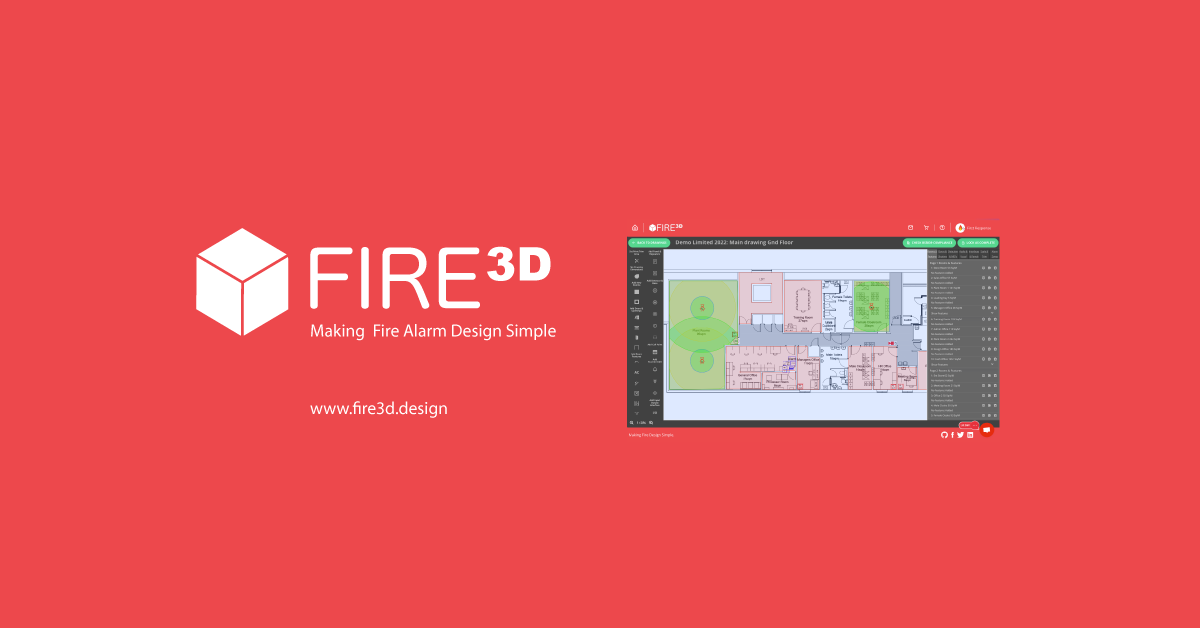
Fire3D checks ambient room noise, sounder decibels, sounder height and sound attenuation through doors, along with room-specific requirements such as high noise level rooms and bedrooms. You see the result visually on your floor plan.
Make designing a breeze.
Try out Fire3D for yourself
Click the 'Click to see what Fire3D can do' button above, or start your free trial using the button below and start designing today.